


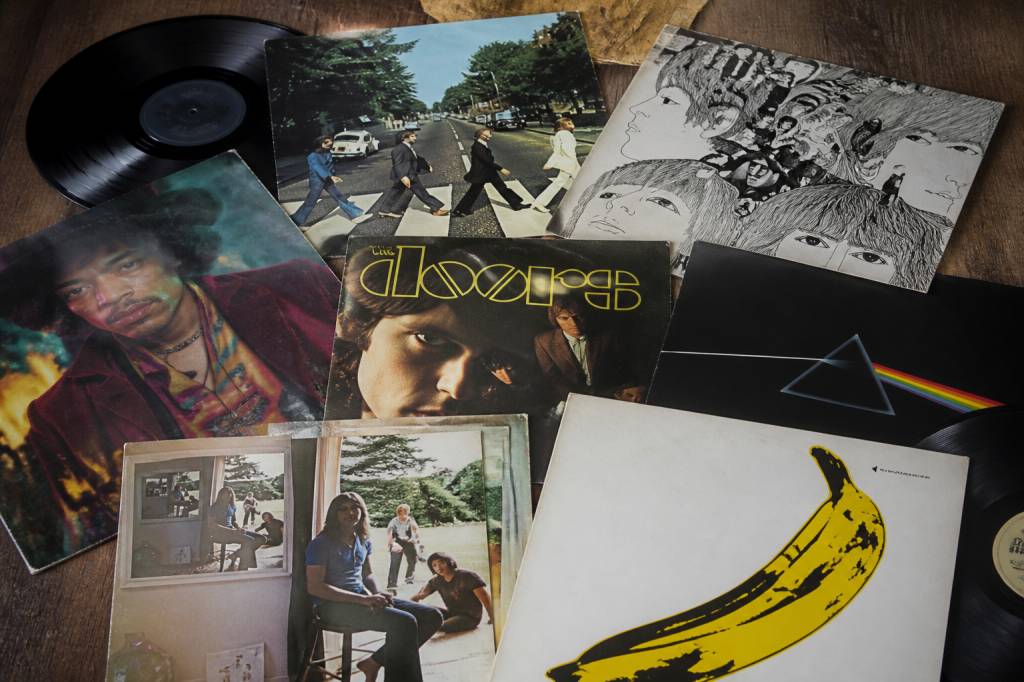
The 1960s were not just another decade in pop history. They were the decade in which albums stopped behaving like simple containers for singles and started acting like statements. Artists pushed beyond three-minute radio bait, labels took bigger risks, and listeners began treating records as full artistic worlds rather than collections of tracks. If you want to understand how modern music became modern, start here.
This was the era of stereo experiments, studio trickery, political upheaval, youth culture, and a rapidly expanding sense of what popular music could be. Rock, soul, folk, jazz, psychedelia, and pop did not just coexist; they collided, borrowed from one another, and occasionally reinvented the rules altogether. Some records captured the spirit of the time. Others helped create it. These are the albums that defined a decade of music.
The Beatles – Revolver (1966)
If the 1960s had a turning point, Revolver is a strong candidate. By 1966, The Beatles were done being merely the world’s biggest band. They were becoming studio artists. The album folds together Indian instrumentation, tape loops, backward guitar, chamber-pop arrangements, and sharply observed lyrics in a way that still feels startlingly modern.
Tracks like “Tomorrow Never Knows” and “Eleanor Rigby” show two extremes of the same creative impulse: one pushes into psychedelic abstraction, the other strips pop down to orchestral desolation. That range is the point. Revolver helped prove that an album could be both commercially dominant and formally adventurous. That lesson echoes everywhere, from classic rock to indie experimentalism.
The Beach Boys – Pet Sounds (1966)
Often described as one of the greatest albums ever made, Pet Sounds was initially a commercial gamble. Brian Wilson stepped away from the surf-pop formula and built something far more intimate, orchestral, and emotionally fragile. The result was not a casual listen. It was a carefully constructed piece of pop architecture.
“Wouldn’t It Be Nice,” “God Only Knows,” and “Caroline, No” turned vulnerability into sonic ambition. Wilson’s production layered strings, bicycle bells, dog barks, horns, and harmonies into songs that sounded as if they were being remembered rather than simply performed. The album influenced everyone from The Beatles to later generations of studio obsessives. If pop was supposed to be lightweight, Pet Sounds got the memo and ignored it completely.
Bob Dylan – Highway 61 Revisited (1965)
Bob Dylan’s move to electric instrumentation was more than a stylistic shift. It was a cultural event. Highway 61 Revisited captures the moment when folk lyricism collided with rock volume and the result was both confrontational and exhilarating. The album opens with “Like a Rolling Stone,” a six-minute detonation that changed expectations for what a single could be, let alone a record.
What makes the album essential is not just its historical symbolism but its language. Dylan’s writing is jagged, surreal, funny, and often ruthless. “Desolation Row” stretches the idea of a song into a cinematic fever dream. “Ballad of a Thin Man” remains one of the sharpest portraits of cultural bewilderment ever committed to tape. The record helped redefine songwriting as literature with attitude.
The Rolling Stones – Let It Bleed (1969)
By the end of the decade, The Rolling Stones had distilled rebellion into something darker, heavier, and less polished than their mid-60s peers. Let It Bleed is ragged in the best possible way. It feels like a record made at the edge of something breaking, which, given the cultural moment, it basically was.
“Gimme Shelter” opens the album with a sense of danger that still lands hard. “You Can’t Always Get What You Want” closes it with weary grandeur. In between, the band balances country, blues, and hard rock with a confidence that would shape the grammar of future guitar bands. If The Beatles represented the studio as possibility, The Rolling Stones represented the studio as a place where things could get messy and still sound immense.
Aretha Franklin – I Never Loved a Man the Way I Love You (1967)
Aretha Franklin’s breakthrough for Atlantic Records was not just a career milestone. It was a correction. Here was a voice that could command a room, a church, and a radio speaker all at once. Backed by the Muscle Shoals rhythm section and guided by producers who finally understood how to frame her power, Franklin delivered an album that became a landmark in soul music.
The title track, “Respect,” and “Do Right Woman, Do Right Man” are essential listening not simply because they are iconic, but because they demonstrate how vocal authority and emotional precision can coexist. Franklin did not just sing songs; she claimed them. Her phrasing, timing, and force made each track feel definitive. In a decade defined by social change, her voice became one of its clearest and most durable expressions.
Marvin Gaye – What’s Going On (1971)
Strictly speaking, this one slips just beyond the 1960s. But any serious discussion of the decade’s defining albums has to acknowledge that the 60s did not end neatly on December 31, 1969. Artistically and culturally, their final arguments carried over. Marvin Gaye’s What’s Going On is a perfect example of that transition.
Why include it? Because it crystallized the social conscience, musical sophistication, and album-centered thinking that the late 1960s made possible. Its songs flow into one another like chapters in the same urgent conversation. “Inner City Blues,” “Mercy Mercy Me,” and the title track address war, pollution, inequality, and spiritual exhaustion without sounding didactic. It is lush, mournful, and deeply human. The album helped expand the role of soul music from romance and dancefloor energy into direct social commentary.
The Velvet Underground & Nico – The Velvet Underground & Nico (1967)
Commercially, this album was not a giant. Culturally, it became a blueprint. Produced by Andy Warhol and released with Nico’s icy vocal presence woven into the mix, The Velvet Underground & Nico sounded like nothing else in mainstream rock at the time. It dealt in urban realism, addiction, alienation, and sexual ambiguity without smoothing the edges.
“Sunday Morning” offers deceptive sweetness. “Heroin” turns dependency into a tense, escalating experience. “I’m Waiting for the Man” is blunt, observational, and unsentimental. The album’s long-term influence is enormous because it gave future artists permission to sound unvarnished, literate, and unafraid of discomfort. Many later scenes, from punk to art rock to indie, owe it a debt they can never quite repay.
Simon & Garfunkel – Bridge Over Troubled Water (1970)
Another album that technically lands just outside the decade, but belongs in the conversation. By 1970, Simon & Garfunkel had refined the delicate fusion of folk melody, pop accessibility, and studio polish that had grown throughout the late 1960s. Bridge Over Troubled Water brought that formula to a commercial and emotional peak.
The title track became a standard almost immediately, but the album’s broader value lies in its control. Songs like “The Boxer” and “El Condor Pasa” show how arrangement can elevate relatively spare material into something enduring. It also marked a decisive moment in the transformation of folk into sophisticated adult-oriented pop. That shift would shape singer-songwriter culture for years to come.
Jimi Hendrix Experience – Are You Experienced (1967)
Jimi Hendrix did not just play guitar. He redefined what the instrument could do in a rock context. Are You Experienced is the sound of a musician arriving with a vocabulary that everyone else would spend years trying to decode. It is explosive, playful, blues-rooted, and technically fearless.
“Purple Haze,” “Foxy Lady,” and “The Wind Cries Mary” combine raw energy with a remarkable sense of texture. Hendrix’s use of feedback, distortion, and studio effects turned sonic chaos into structure. In practical terms, the album widened the language of rock guitar. In cultural terms, it made virtuosity feel dangerous again. Not many records can say that with a straight face.
Joni Mitchell – Clouds (1969)
Joni Mitchell’s early work helped establish the album as a space for confessional writing that was sharp rather than self-indulgent. Clouds is a key example. It features songs that are intimate without being soft, poetic without floating away from reality. Mitchell had already begun to separate herself from the male-dominated folk scene by writing with unusual harmonic logic and lyrical precision.
“Both Sides, Now” became one of her best-known songs, but the album’s deeper value lies in its consistency of voice. Mitchell was building a model for the songwriter as observer, analyst, and emotional cartographer. That model would become central to the 1970s, but the groundwork was laid here, in the closing stretch of the 60s.
Why these albums still matter
The obvious reason is influence. These records shaped genres, inspired artists, and changed industry expectations. But the deeper reason is simpler: they captured the moment when the album became the main battlefield for musical ambition. Singles still mattered, of course. Radio still mattered. Yet the 1960s made it clear that a great album could do more than sell records. It could define a generation’s mood, language, and self-image.
They also show how broad the decade really was. The 60s were not owned by one genre or one region. British Invasion rock, American soul, psychedelic experimentation, protest folk, and avant-garde noise all fed the same ecosystem. That diversity is part of why the decade remains so exhaustively discussed. It was not one sound. It was a dozen conversations happening at once.
And if you are wondering why these albums still dominate best-of lists and critical debates, the answer is blunt: they still sound alive. Not frozen in amber, not museum pieces, but records with tension, risk, and purpose. That is the bar the 1960s set. Plenty of albums have tried to clear it since. Very few have managed it with the same level of impact.
For listeners coming to the decade now, the best approach is not to treat these records as homework. Put them on and hear the transformation happen in real time. You can practically listen to the 20th century changing its mind.
- Start with Pet Sounds if you want to hear pop become emotionally complex.
- Go to Revolver for studio innovation and fearless experimentation.
- Choose Highway 61 Revisited if you want songwriting to feel like a live wire.
- Pick I Never Loved a Man the Way I Love You for soul at full command.
- End with The Velvet Underground & Nico if you want the decade’s shadow side in full view.
The 1960s did not just produce great albums. They produced the idea that great albums should matter culturally, not just commercially. That may be the decade’s biggest legacy of all.