


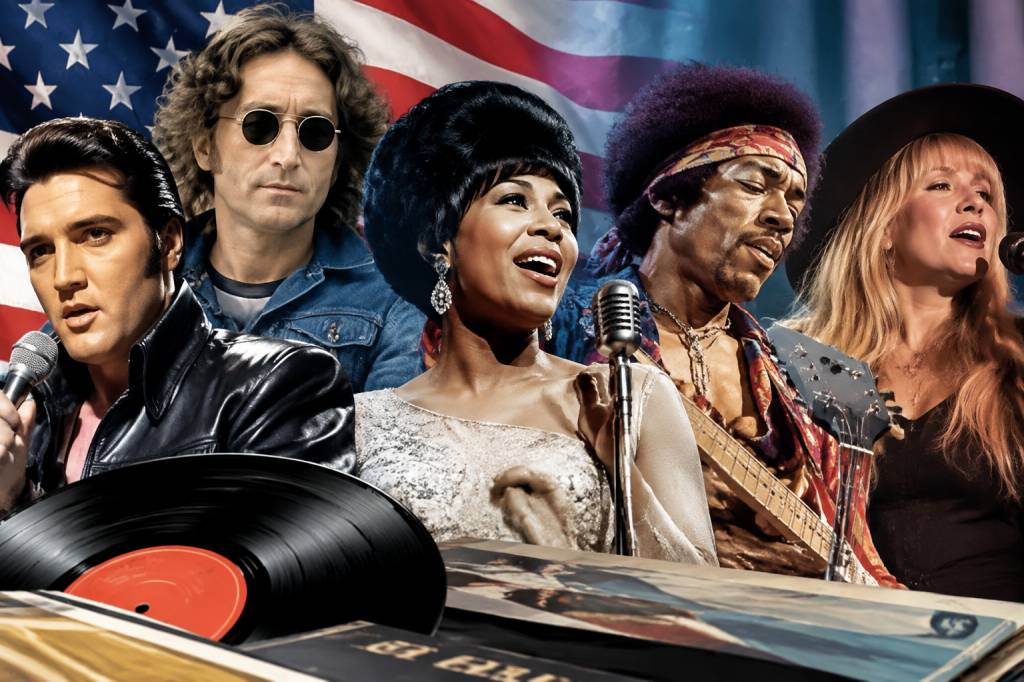
Popular music does not evolve in a straight line. It moves through collisions: blues meeting country, gospel entering the mainstream, Caribbean rhythms reshaping rock, and studio technology becoming part of the composition itself. Some songs succeed for a season; others alter the vocabulary of music long after their original release.
The ten tracks below are not simply “greatest hits.” They are turning points. Each one changed what artists could record, what audiences expected to hear, or how the music business understood its own power. The list is necessarily selective—American popular music is too vast for a definitive ranking—but every song left a measurable mark on the culture around it.
“Hound Dog” — Big Mama Thornton (1952)
Before Elvis Presley turned “Hound Dog” into a global rock ’n’ roll spectacle, Willie Mae “Big Mama” Thornton recorded the song in Los Angeles in 1952. Written by Jerry Leiber and Mike Stoller, the track reached No. 1 on Billboard’s R&B chart and remained there for seven weeks.
Thornton’s version is raw, confrontational and unmistakably rooted in the Black blues tradition. Her vocal performance carries both humor and threat, while Johnny Otis’s band gives the song a hard, swinging pulse. This was not polished pop. It was direct, physical and built for impact.
Presley’s later version, released in 1956, became more commercially famous, but Thornton’s recording reveals where the song’s power originated. It also highlights a recurring pattern in popular music: Black artists create a sound, and the mainstream industry often rewards a white performer for repackaging it. “Hound Dog” helped establish the blues-driven energy that would define early rock ’n’ roll.
“That’s All Right” — Elvis Presley (1954)
Elvis Presley’s first single for Sun Records is often treated as the birth certificate of rock ’n’ roll. That description is too simple, but the record remains a crucial musical turning point. Recorded in Memphis with guitarist Scotty Moore and bassist Bill Black, “That’s All Right” fused Arthur “Big Boy” Crudup’s blues composition with a brisk, country-inflected rhythm.
Presley did not invent the ingredients. Black musicians, country performers and regional radio DJs had been blending blues, gospel, jazz and hillbilly music for years. What changed was the way the elements were presented—and the speed with which the new sound moved into the national spotlight.
Sam Phillips, Sun’s founder, famously wanted to find a white singer who could reach a wider audience while carrying the emotional force of Black music. Presley became that bridge, though the commercial consequences were far more complicated than the mythology suggests. “That’s All Right” helped turn regional musical exchange into a national pop phenomenon.
“A Change Is Gonna Come” — Sam Cooke (1964)
Sam Cooke had already mastered the mechanics of pop success. He was a major hitmaker, a gifted songwriter and one of the most recognizable voices in American music. “A Change Is Gonna Come,” released after his death in December 1964, showed another side of his artistry: the ability to transform personal grief and political tension into an orchestral anthem.
Inspired in part by Bob Dylan’s “Blowin’ in the Wind” and by Cooke’s own experience with racial discrimination, the song was recorded with sweeping strings, a restrained rhythm section and Cooke’s controlled but increasingly impassioned vocal. Its lyric moves from private pain to collective hope without pretending that progress will be easy.
The song did not become Cooke’s biggest chart hit at the time, but its cultural influence expanded steadily. It became deeply associated with the Civil Rights Movement and remains a reference point for protest music, soul and contemporary R&B. Few songs have carried such grandeur without losing their human scale.
“Like a Rolling Stone” — Bob Dylan (1965)
At more than six minutes, “Like a Rolling Stone” was an awkward proposition for commercial radio in 1965. It was also impossible to ignore. Dylan’s song abandoned the tidy structure of the conventional pop single and replaced it with a snarling organ line, a loose rock arrangement and a lyric full of accusation, disillusionment and open-ended possibility.
The single reached No. 2 on the Billboard Hot 100, proving that a long, lyrically dense rock song could compete at the center of popular culture. Its impact was not just commercial. Dylan expanded the role of the singer-songwriter, demonstrating that pop lyrics could be literary, abrasive and politically suggestive without explaining themselves.
The recording also marked a decisive shift toward electric rock for Dylan, provoking controversy among parts of the folk community. That tension mattered. “Like a Rolling Stone” made artistic restlessness commercially viable—and gave generations of musicians permission to make songs that refused to behave.
“Respect” — Aretha Franklin (1967)
Otis Redding wrote and recorded “Respect” as a plea from a working man returning home. Aretha Franklin transformed it into something broader, sharper and more politically charged. Her 1967 version moved the song from personal negotiation to a demand for dignity, autonomy and recognition.
Franklin’s vocal is the centerpiece, but the arrangement is equally important. The clipped rhythm, saxophone accents, backing vocals and instantly memorable “R-E-S-P-E-C-T” refrain create a song that is both sophisticated and impossible not to join. The performance sits at the intersection of soul, gospel and pop craft.
“Respect” became Franklin’s second No. 1 single and a defining statement of the late 1960s. It resonated with the women’s rights movement and the struggle for racial equality, while remaining a fully functional pop record. That balance is rare: a song can carry historical weight and still make an entire room sing along.
“What’s Going On” — Marvin Gaye (1971)
Motown had built its empire on precision, romance and disciplined hitmaking. Marvin Gaye’s “What’s Going On” challenged that formula from within. Released in 1971, the song addressed police violence, war, poverty and social division through a warm, fluid arrangement that sounded radically different from the label’s earlier singles.
Producer and songwriter Renaldo “Obie” Benson was inspired by the unrest surrounding the 1967 Detroit riots. Gaye developed the idea with Benson and songwriter Al Cleveland, then recorded the track with layered vocals and a relaxed groove. The opening saxophone, overdubbed vocal harmonies and continuous flow create the sensation of a conversation unfolding rather than a conventional verse-chorus single.
Berry Gordy reportedly disliked the song at first, calling it a protest record. Gaye insisted, and Motown released it. “What’s Going On” reached No. 2 on the Billboard Hot 100 and changed expectations for socially conscious soul. It proved that political music could be elegant, intimate and commercially powerful.
“Good Times” — Chic (1979)
“Good Times” is often described as a disco classic, but its influence stretches far beyond the dance floor. Built by Nile Rodgers and Bernard Edwards, the track features one of the most imitated bass lines in popular music, played by Edwards with extraordinary economy and precision.
The song reached No. 1 on the R&B chart and No. 1 on the Billboard Hot 100. Its groove also became foundational to early hip-hop. The Sugarhill Gang’s “Rapper’s Delight” famously used an interpolation of the bass line, while countless DJs and producers sampled or reworked the track in the decades that followed.
“Good Times” demonstrated that a bass part could function as the main hook. It also showed how disco’s rhythmic architecture could migrate into rap, house and electronic dance music. The track’s legacy is not simply nostalgia for the late 1970s; it is embedded in the mechanics of modern production.
“Rapper’s Delight” — The Sugarhill Gang (1979)
Hip-hop began as a local culture of DJs, MCs, dancers and graffiti artists, particularly in the Bronx. “Rapper’s Delight” brought that culture into the national marketplace. Released by Sugar Hill Records in 1979, the single used the groove associated with Chic’s “Good Times” and placed extended rapping at the center of a commercial recording.
The track was not the first rap record, nor did it accurately represent the full complexity of Bronx hip-hop. It was, however, a crucial breakthrough. Its success introduced millions of listeners to MC-based performance and demonstrated that rap could occupy the pop charts without abandoning its rhythmic focus.
Its structure also predicted the logic of hip-hop production: recognizable grooves, loop-based arrangements, personality-driven verses and the transformation of existing recordings into new musical material. From sampling culture to contemporary chart rap, the industry still operates in the long shadow of “Rapper’s Delight.”
“Billie Jean” — Michael Jackson (1983)
“Billie Jean” changed the scale of the pop single. Produced by Quincy Jones and written by Michael Jackson, the track combined a muscular bass line, stark rhythmic space, synthesizers and Jackson’s highly controlled vocal performance. It was sleek, tense and engineered for maximum replay value.
The song reached No. 1 in the United States and became a central part of the early music-video era. Jackson’s performance of “Billie Jean” on the television special Motown 25: Yesterday, Today, Forever in 1983—particularly the debut of his moonwalk—turned choreography into a major component of pop stardom.
Its impact extended to MTV, where the visibility of a Black artist at the channel’s center helped challenge the industry’s narrow assumptions about the rock audience. “Billie Jean” was not merely a hit. It was a complete pop system: song, production, image, dance and visual identity operating as one machine.
“Smells Like Teen Spirit” — Nirvana (1991)
When “Smells Like Teen Spirit” broke through in 1991, it disrupted the polished hierarchy of American rock. Nirvana’s single combined a quiet-loud dynamic, distorted guitars, a deliberately blurred vocal and lyrics that sounded more like fragments than a manifesto.
The song reached No. 6 on the Billboard Hot 100, while the album Nevermind eventually displaced Michael Jackson’s Dangerous at the top of the Billboard 200. That reversal was symbolic. Alternative rock, once treated as a niche market, had become the center of mainstream youth culture.
Its success accelerated the commercial rise of grunge and reshaped the record industry’s approach to guitar music. Labels began searching for authenticity—often with predictable results—and the polished hair-metal aesthetic rapidly lost cultural authority. Nirvana did not destroy pop music; it reminded the mainstream that discomfort could sell.
“Crazy in Love” — Beyoncé featuring Jay-Z (2003)
“Crazy in Love” announced Beyoncé’s solo career with unusual force. Released in 2003, the track combined a brassy horn hook derived from the Chi-Lites’ “Are You My Woman (Tell Me So),” a hard-driving hip-hop rhythm and Beyoncé’s expansive vocal performance. Jay-Z’s guest verse completed the crossover design.
The song reached No. 1 on the Billboard Hot 100 and won two Grammy Awards. More importantly, it established a template for 21st-century pop: genre boundaries became flexible, collaborations became strategic, and a hit could be built as much around sonic identity and visual performance as around a traditional melody.
“Crazy in Love” also captured the growing integration of R&B, hip-hop and mainstream pop. Beyoncé’s career would later expand into ambitious albums, visual projects and political expression, but the song’s significance lies in its opening statement. It presented pop stardom as total authorship: voice, movement, production, image and business control working together.
Why these songs still matter
These recordings remain relevant because they changed systems, not only playlists. “Hound Dog” and “That’s All Right” show how American genres were built through cultural exchange—and unequal credit. “A Change Is Gonna Come,” “Respect” and “What’s Going On” demonstrate how popular songs can become public language during periods of political conflict.
“Like a Rolling Stone” expanded the artistic ambition of the single. “Good Times” and “Rapper’s Delight” revealed the creative possibilities of rhythm and reuse. “Billie Jean” turned the pop star into a multimedia performer, while “Smells Like Teen Spirit” proved that the mainstream could be overturned from the margins. “Crazy in Love” carried that evolution into an era where genre itself became increasingly porous.
The history of popular music is not preserved only in awards, sales figures or chart positions. It survives in the sounds that later artists borrow, challenge and rebuild. That is the real test of a landmark song: decades later, can you still hear its influence in the music around you?