


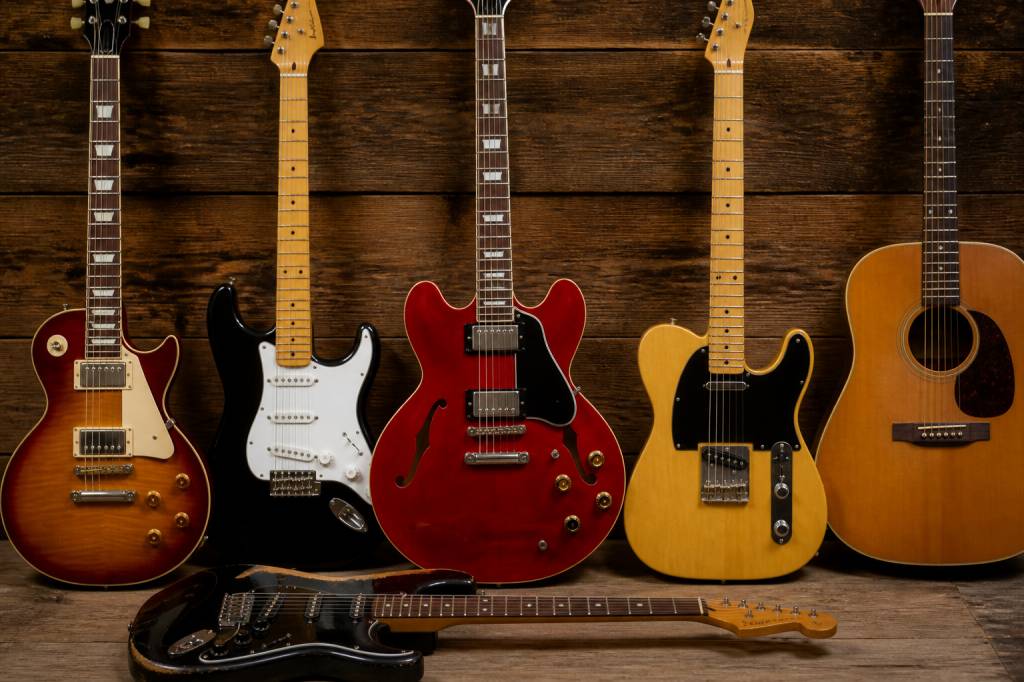
Some guitars become famous because they sound extraordinary. Others earn their place in history because a particular artist turns them into an extension of their own voice. The most important instruments do both. They alter recording techniques, redefine genres, inspire manufacturers and, occasionally, become as recognizable as the musicians who played them.
Choosing the ten best guitars of all time is inevitably subjective. “Best” can mean the most influential, the most innovative, the most collectable or simply the instrument responsible for an unforgettable riff. The list below focuses on guitars that changed the course of popular music—not merely expensive models or technically impressive designs.
Fender Stratocaster
Introduced in 1954, the Fender Stratocaster remains the reference point for the modern electric guitar. Its contoured double-cutaway body, three-pickup configuration and tremolo bridge offered players a combination of comfort, tonal variety and visual identity that was unusual for the period.
Buddy Holly helped bring the Stratocaster into the public eye, but its most enduring associations came later. Jimi Hendrix transformed the instrument’s sound through feedback, volume manipulation and aggressive use of the tremolo arm. Eric Clapton, Jeff Beck, David Gilmour and Stevie Ray Vaughan each demonstrated a different side of its personality.
The Stratocaster’s five-way pickup selector became standard in the 1970s, although players had already discovered ways to balance the switch between positions on earlier models. Its tones can be glassy, sharp, muscular or almost vocal. That versatility explains why it belongs equally to blues, rock, funk, country and pop.
- Key contribution: Defined the sound and ergonomics of the modern solid-body electric guitar.
- Iconic users: Jimi Hendrix, Eric Clapton, David Gilmour and Stevie Ray Vaughan.
Gibson Les Paul Standard
The Gibson Les Paul Standard is one of the central pillars of rock guitar. Designed in collaboration with guitarist and inventor Les Paul, the original model appeared in 1952. The later sunburst versions, particularly those made between 1958 and 1960, became prized for their powerful humbucking pickups and sustain.
Unlike the bright, percussive character of a Stratocaster, the Les Paul delivers weight. Its mahogany body and neck, maple top and dual humbuckers produce a thick midrange that cuts through loud amplifiers without losing warmth. Jimmy Page used a Les Paul to build the heavy architecture of Led Zeppelin, while Slash made the model inseparable from the sound of late-1980s hard rock.
Peter Green’s famously distinctive Les Paul, later used by Gary Moore, also demonstrated how phase relationships between pickups could create an unusually nasal, haunting tone. The guitar is not subtle, but subtlety has never been its primary mission. When the riff needs authority, the Les Paul usually arrives early.
- Key contribution: Established the high-powered humbucker sound that shaped hard rock and heavy blues.
- Iconic users: Les Paul, Jimmy Page, Slash, Duane Allman and Gary Moore.
Fender Telecaster
The Telecaster was the first commercially successful solid-body electric guitar, launched by Fender in the early 1950s. Its original design was straightforward: a slab body, two single-coil pickups, a bolt-on neck and a bridge that prioritized clarity. That simplicity proved remarkably durable.
Country players valued the Telecaster’s sharp attack and reliable tuning. Rock musicians appreciated its ability to slice through dense arrangements. Keith Richards used one to establish the muscular, open-chord language of the Rolling Stones, while Bruce Springsteen turned the instrument into a symbol of working-class American rock.
The Telecaster’s influence extends well beyond its signature “twang.” Its bridge pickup can sound ferocious through an overdriven amplifier, while the neck pickup offers a surprisingly rounded tone. Artists including Prince, Andy Summers and Jonny Greenwood have shown that the model can handle funk, post-punk and experimental textures without losing its identity.
Few designs have remained so recognizable while accommodating so many musical approaches. The Telecaster is not glamorous in the traditional sense. It is simply effective—and often that is more important.
Gibson SG
Gibson introduced the SG in 1961 as a replacement for the Les Paul model, although Les Paul himself did not approve of the new design. With its thin double-cutaway body, sharp horns and easy access to the upper frets, the SG looked radically modern compared with Gibson’s earlier instruments.
Its light weight and aggressive humbucker tone made it especially attractive to rock players. Tony Iommi used a Gibson SG to create the dark, defining riffs of Black Sabbath, helping establish the vocabulary of heavy metal. Angus Young later made the red SG a visual and sonic trademark of AC/DC.
The design also found a home in punk, alternative rock and indie music. Its neck access encourages high-register playing, while the body’s resonance produces a direct, slightly raw character. The SG can sound clean and articulate, but it becomes most convincing when pushed hard through a loud amplifier.
- Key contribution: Combined a lightweight body with powerful humbuckers and exceptional upper-fret access.
- Iconic users: Tony Iommi, Angus Young, Robby Krieger and Derek Trucks.
Rickenbacker 360/12
The Rickenbacker 360/12 helped define the sound of 1960s pop. Its twelve-string design delivered a bright, chiming texture that became one of the decade’s most recognizable sonic signatures. George Harrison’s use of a Rickenbacker 360/12 during the Beatles’ breakthrough years made the instrument globally famous.
The guitar’s jangling tone can be heard on tracks such as “A Hard Day’s Night,” where the twelve-string’s shimmer became part of the arrangement rather than a decorative effect. Roger McGuinn later built much of the Byrds’ sound around a Rickenbacker twelve-string, using compression and amplification to create a sustained, almost orchestral quality.
Rickenbacker instruments are not simply twelve-string versions of conventional guitars. Their distinctive pickups, construction and shorter scale contribute to a sharp, percussive attack. The result influenced folk-rock, power pop, alternative rock and indie music for generations.
Whenever a guitar part sounds like sunlight reflecting off chrome, there is a reasonable chance the Rickenbacker’s legacy is involved.
Gibson ES-335
The Gibson ES-335, launched in 1958, occupies a productive middle ground between solid-body and fully hollow electric guitars. Its semi-hollow construction uses a solid maple center block, reducing feedback while preserving some of the resonance associated with jazz instruments.
That hybrid design made the ES-335 unusually flexible. It can deliver warm, rounded jazz tones, but it also handles blues overdrive and sustained rock lines with authority. Chuck Berry used the model’s predecessor, the ES-355, during his defining years, while Eric Clapton helped establish the ES-335 as a serious blues-rock instrument with Cream.
BB King’s beloved Gibson ES-345, “Lucille,” belongs to the same family of semi-hollow designs. King’s playing demonstrated that expressive vibrato, phrasing and dynamics matter more than sheer volume. The ES-335 rewards that approach, responding clearly to changes in pick attack and amplifier gain.
- Key contribution: Bridged the tonal worlds of jazz, blues and rock.
- Iconic users: Eric Clapton, Chuck Berry, BB King and Larry Carlton.
Gretsch White Falcon
The Gretsch White Falcon is one of the most visually striking guitars ever produced. Originally introduced in 1955 as a high-end hollow-body model, it featured a white finish, gold hardware and an oversized body that made understatement impossible.
Its sound is equally distinctive: bright, open and resonant, with a snap that works particularly well for rockabilly, country and roots rock. Chet Atkins was closely associated with Gretsch guitars, helping establish the company’s instruments as serious tools for technically precise players. Billy Duffy of The Cult later used the White Falcon to add grandeur and shimmer to arena-sized rock.
Neil Young’s use of a White Falcon brought a different perspective. Through loud amplification and heavy effects, he turned the elegant hollow-body into a volatile rock instrument. That contrast is central to the guitar’s appeal. It may look like a museum piece, but it is perfectly capable of making a large amplifier behave badly.
Fender Jaguar
The Fender Jaguar arrived in 1962 as the company’s top-of-the-line electric guitar. Its shorter 24-inch scale, offset body and complex switching system made it distinct from both the Stratocaster and Telecaster. The instrument was initially marketed toward surf and instrumental players, but its most important cultural impact came later.
Alternative and punk musicians embraced the Jaguar’s unusual character. Kurt Cobain used modified Jaguars during Nirvana’s rise, while Johnny Marr developed a close relationship with the model through The Smiths. Its rhythm and lead circuits allow players to move between bright, cutting sounds and darker, more muted textures.
The Jaguar’s floating tremolo and pickup controls can be demanding. That is part of the appeal. It does not always behave like a predictable workhorse, and players often exploit its quirks rather than eliminate them. In the hands of the right musician, its slightly unstable personality becomes an advantage.
Gibson Flying V
When Gibson released the Flying V in 1958, the guitar looked more like a piece of futuristic industrial design than a conventional musical instrument. The original production run was commercially unsuccessful, but the model gained credibility as musicians began to recognize its stage presence and powerful tone.
Albert King used a Flying V to create a distinctive blues identity, often playing the instrument upside down because he was left-handed but used a right-handed guitar. Lonnie Mack also helped establish the model’s blues credentials. Later, heavy metal players adopted the sharp body shape as a visual representation of speed and aggression.
The Flying V’s design is not only theatrical. Its symmetrical body can provide excellent access across the fretboard, while its humbuckers offer the sustain expected from a Gibson. It remains a reminder that commercial failure and historical importance are not mutually exclusive.
PRS Custom 24
Paul Reed Smith introduced the Custom 24 in the mid-1980s, at a moment when many players were seeking instruments that combined vintage warmth with modern precision. The model’s carved maple top, dual humbuckers, tremolo bridge and 24-fret neck offered an alternative to the established Fender-Gibson divide.
Carlos Santana became one of PRS’s most recognizable advocates, using the guitar’s sustain and smooth upper-register response to shape his singing lead tone. The Custom 24 also appealed to studio musicians and technically demanding players who wanted a stable instrument with broad tonal coverage.
PRS did not invent the idea of combining classic guitar features. Its importance lies in refining that formula for a new generation. The company helped normalize premium manufacturing details—precise fretwork, carefully voiced pickups and consistent quality—as central selling points in the modern electric-guitar market.
Martin D-28
No list of influential guitars is complete without an acoustic instrument. The Martin D-28 has been one of the defining steel-string dreadnoughts since its introduction in 1931. Its large body, spruce top and rosewood back and sides produce a powerful bass response and strong projection.
The D-28 became a foundation of bluegrass, folk, country and singer-songwriter music. Its volume allowed acoustic players to compete with banjos and other instruments in ensemble settings, while its balanced tone made it equally effective for fingerpicking and strumming.
Hank Williams, Bob Dylan, Neil Young and countless bluegrass musicians helped cement the dreadnought’s cultural importance. The D-28 is not built around novelty. Its achievement is more fundamental: it established a template that remains central to acoustic guitar design nearly a century later.
These ten instruments did more than accompany famous performances. They influenced manufacturing, studio production, stage design and the expectations of musicians themselves. From the Stratocaster’s adaptable circuitry to the Martin D-28’s commanding acoustic projection, each guitar solved a practical problem while creating a recognizable musical language.
The best guitar, of course, is still the one that makes a player want to pick it up again. But history has already made its judgment on these models. Their shapes, tones and imperfections continue to appear wherever popular music is being written, recorded or played at excessive volume.